Sleep & Learning
- Download Poster
- View Poster
- May 23, 2026
Sleep & Learning
Sleep consolidates memories, supports learning and helps the brain prepare for new information.
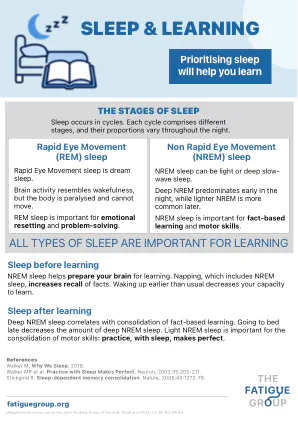
The stages of sleep
Sleep occurs in cycles. Each cycle comprises different stages, and their proportions vary throughout the night.
1. Rapid Eye Movement (REM) sleep
Rapid Eye Movement sleep is dream sleep. Brain activity resembles wakefulness, but the body is paralysed and cannot move. REM sleep is important for emotional resetting and problem-solving.
2. Non Rapid Eye Movement (NREM) sleep
NREM sleep can be light or deep slow-wave sleep. Deep NREM predominates early in the night, while lighter NREM is more common later. NREM sleep is important for fact-based learning and motor skills.
Sleep before learning
NREM sleep helps prepare your brain for learning. Napping, which includes NREM sleep, increases recall of facts. Waking up earlier than usual decreases your capacity to learn.
Sleep after learning
Deep NREM sleep correlates with consolidation of fact-based learning. Going to bed late decreases the amount of deep NREM sleep. Light NREM sleep is important for the consolidation of motor skills: practice, with sleep, makes perfect.
Key messages
All types of sleep are important for learning. Prioritising sleep will help you learn.
References
- Walker M, Why We Sleep, 2018.
- Walker MP et al. Practice with Sleep Makes Perfect. Neuron, 2002;35:205-211.
- Stickgold R. Sleep-dependent memory consolidation. Nature, 2005;43:1272-78.